
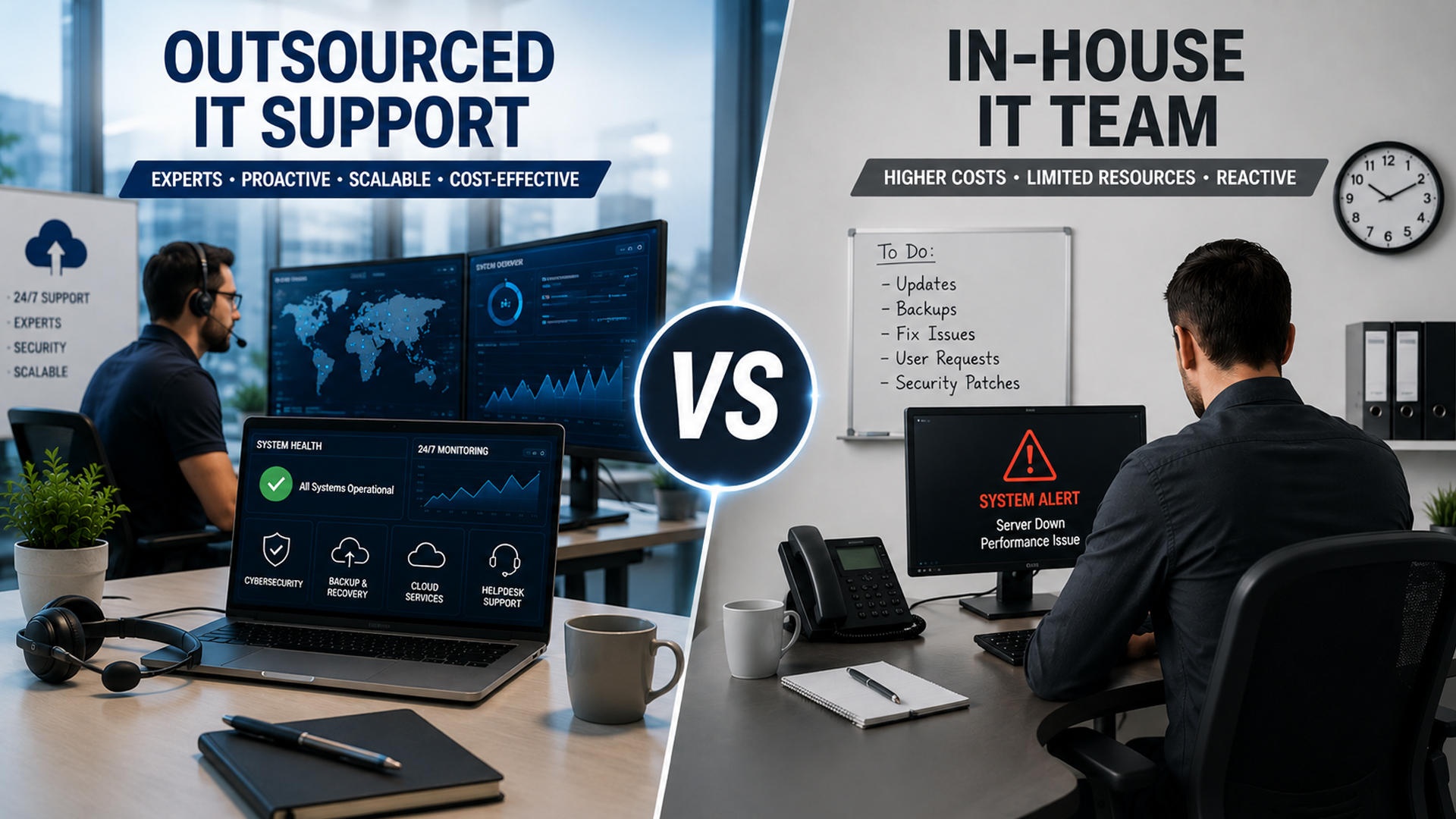
Technology has become a critical part of every business operation. From communication and cloud applications to cybersecurity and data management, companies depend on reliable IT systems every day.
As businesses grow, one important decision emerges: should they hire an internal IT team or partner with an outsourced IT support provider?
For many small and medium-sized businesses, building a full IT department can be expensive and difficult to scale. At the same time, relying on unmanaged technology can create security risks, downtime, and productivity issues.
In 2026, businesses need IT solutions that provide strong security, fast support, and long-term technology planning.
Understanding the difference between outsourced IT support and in-house IT teams helps organizations choose the right approach for their goals.
Quick Answer: Outsourced IT Support vs In-House IT Team
- An in-house IT team consists of employees dedicated to managing company technology internally.
- Outsourced IT support provides access to external IT experts who manage systems, security, and support.
- In-house teams offer direct control, while MSPs provide broader expertise and scalability.
- Outsourced IT support is often more cost-effective for small and medium-sized businesses.
- Many organizations use MSPs to supplement internal IT teams with additional resources.
What Is Outsourced IT Support?
Outsourced IT support means partnering with an external technology provider to manage some or all IT responsibilities.
A managed service provider (MSP) acts as an extension of the business and provides professional IT services without requiring the company to hire multiple full-time employees.
Outsourced IT providers typically handle:
- Network monitoring
- Cybersecurity management
- Cloud support
- Data backup
- Software updates
- Helpdesk services
- IT strategy
- Compliance support
Instead of waiting for problems to occur, MSPs use proactive technology management to identify and resolve issues before they impact business operations.
For small businesses, outsourced IT support provides access to experienced professionals and advanced tools without the cost of maintaining a large internal department.
What Is an In-House IT Team?
An in-house IT team consists of employees hired directly by a company to manage technology internally.
Depending on the size of the organization, an internal IT department may include:
- IT managers
- Network administrators
- System engineers
- Helpdesk technicians
- Cybersecurity specialists
In-house teams are responsible for managing business technology, troubleshooting problems, supporting employees, and implementing IT strategies.
For larger organizations with complex technology environments, internal IT teams can provide valuable business-specific knowledge and direct control.
However, maintaining a complete IT department requires significant investment in hiring, training, tools, and ongoing development.
Why This Decision Matters in 2026
The technology landscape has become more complex than ever.
Businesses must manage:
Advanced Cybersecurity Threats
Cybercriminals continue targeting organizations of all sizes.
Companies need protection against:
- Ransomware
- Phishing attacks
- Data breaches
- Credential theft
- Malware
Both internal IT teams and MSPs must maintain strong cybersecurity practices.
However, MSPs often specialize in cybersecurity and provide access to security tools that may be expensive for smaller businesses to implement independently.
Cloud Technology Growth
Businesses increasingly rely on:
- Microsoft 365
- Cloud storage
- SaaS applications
- Remote collaboration platforms
Managing cloud environments requires specialized knowledge and ongoing monitoring.
Talent Shortages
Finding experienced IT professionals has become increasingly challenging.
Many businesses struggle to hire specialists in areas such as:
- Cybersecurity
- Cloud computing
- Network management
- Compliance
Outsourcing provides immediate access to experienced professionals.
AI and Technology Innovation
New technologies require businesses to continuously update their IT strategies.
MSPs help organizations adopt new solutions while maintaining security and reliability.
Outsourced IT Support vs In-House IT Team: Key Differences
Cost Comparison
One of the biggest differences between outsourced IT support and internal teams is cost.
An internal IT department requires expenses such as:
- Salaries
- Benefits
- Training
- Software licenses
- Hardware
- Security tools
A single IT employee may not have expertise in every technology area.
For example, a network administrator may not specialize in cybersecurity or cloud management.
Outsourced IT support provides access to a team of experts for a predictable monthly investment.
Expertise and Resources
Internal IT teams usually have strong knowledge of company-specific systems.
However, MSPs provide broader expertise across multiple industries and technologies.
An MSP may provide specialists in:
- Cybersecurity
- Cloud solutions
- Compliance
- Backup recovery
- Network infrastructure
Scalability
Businesses change over time.
New employees, locations, applications, and security requirements create additional IT needs.
Outsourced IT providers can scale services as businesses grow.
Internal teams may require additional hiring to handle increased responsibilities.
Response Time
Downtime can quickly impact business operations.
MSPs often provide structured support processes, monitoring systems, and dedicated teams to respond quickly.
Internal teams may become overwhelmed when multiple issues occur simultaneously.
Benefits of Outsourced IT Support
Lower Technology Costs
Outsourcing reduces the need for expensive hiring and infrastructure investments.
Businesses gain access to professional IT services without building a large internal department.
24/7 Monitoring
Many MSPs provide continuous monitoring to identify problems before they become major issues.
This helps reduce:
- System failures
- Security incidents
- Productivity interruptions
Stronger Cybersecurity
MSPs provide specialized security services including:
- Threat detection
- Endpoint security
- Email protection
- Vulnerability management
- Security assessments
Businesses can improve their cybersecurity posture without hiring dedicated security experts.
Access to Advanced Tools
Enterprise-level IT tools can be expensive for small businesses.
MSPs provide access to:
- Monitoring platforms
- Security software
- Backup solutions
- Automation tools
Strategic IT Guidance
MSPs do more than fix technical problems.
They help businesses plan:
- Technology upgrades
- Security improvements
- Cloud adoption
- Long-term IT strategies
Benefits of an In-House IT Team
Direct Control
Internal employees have a deep understanding of company operations and processes.
Faster Internal Communication
Employees can communicate directly with IT staff within the organization.
Customized Support
Internal teams can build technology solutions specifically around business needs.
Company Knowledge
Over time, internal IT professionals develop strong familiarity with company systems.
Risks of Relying Only on In-House IT
Limited Expertise
A small IT team may struggle to manage every technology requirement.
Higher Costs
Hiring multiple specialists can become expensive.
Limited Availability
Internal teams may not provide after-hours support.
Security Gaps
Without dedicated cybersecurity expertise, businesses may miss important risks.
Risks of Choosing Only Reactive IT Support
Businesses that wait until problems happen often experience:
- Longer downtime
- Higher repair costs
- Increased security exposure
- Lost productivity
Modern IT requires proactive management.
How MSPs Support Businesses
A managed service provider helps businesses through a structured approach.
Assessment
The MSP reviews existing systems, technology goals, and security risks.
Risk Identification
Potential issues are identified, including:
- Outdated software
- Security vulnerabilities
- Backup weaknesses
Implementation
The MSP deploys solutions such as:
- Monitoring tools
- Cybersecurity controls
- Backup systems
- Cloud improvements
Monitoring
Systems are continuously reviewed to detect issues early.
Continuous Improvement
The MSP recommends improvements as technology and business needs change.
Industry Examples
Healthcare
Healthcare organizations require secure systems to protect patient information.
MSPs help maintain cybersecurity and compliance requirements.
Financial Services
Financial companies need strong security and reliable access to sensitive data.
Outsourced IT support helps reduce technology risks.
Law Firms
Legal businesses rely on secure document systems and communication platforms.
MSPs protect confidential client information.
Retail
Retail companies need reliable payment systems and customer platforms.
IT disruptions can directly impact sales.
Manufacturing
Manufacturers depend on technology for production and operations.
Reliable IT support helps reduce operational downtime.
Cost and ROI Comparison
The right IT approach depends on business size, goals, and complexity.
In-House IT Costs Include:
- Employee salaries
- Benefits
- Recruiting expenses
- Training
- Technology tools
Outsourced IT Costs Include:
- Monthly service fees
- Customized support packages
- Technology management services
The ROI of outsourced IT support comes from:
- Reduced downtime
- Improved cybersecurity
- Faster issue resolution
- Better technology planning
- Lower emergency repair costs
FAQ
It depends on the business. Many small and medium-sized businesses benefit from outsourced IT because it provides expertise and scalability at a lower cost.
Yes, for many small businesses. Larger organizations often use MSPs to support internal teams.
Businesses outsource IT to reduce costs, improve security, access experts, and receive proactive technology management.
Yes. Professional MSPs use cybersecurity tools and processes to protect business systems.
Costs depend on business size, number of users, services required, and technology complexity.
Most MSPs provide cybersecurity solutions including monitoring, threat protection, backups, and security management.
Conclusion
Both in-house IT teams and outsourced IT support can provide value depending on business needs.
However, many small and medium-sized businesses benefit from partnering with an MSP because it provides access to expert support, advanced security tools, and scalable solutions without the cost of building a large internal department.
In 2026, businesses need proactive IT management that prevents problems, protects data, and supports growth.
If your organization wants to improve reliability, security, and technology performance, request an IT assessment to explore how outsourced IT support can help your business.