
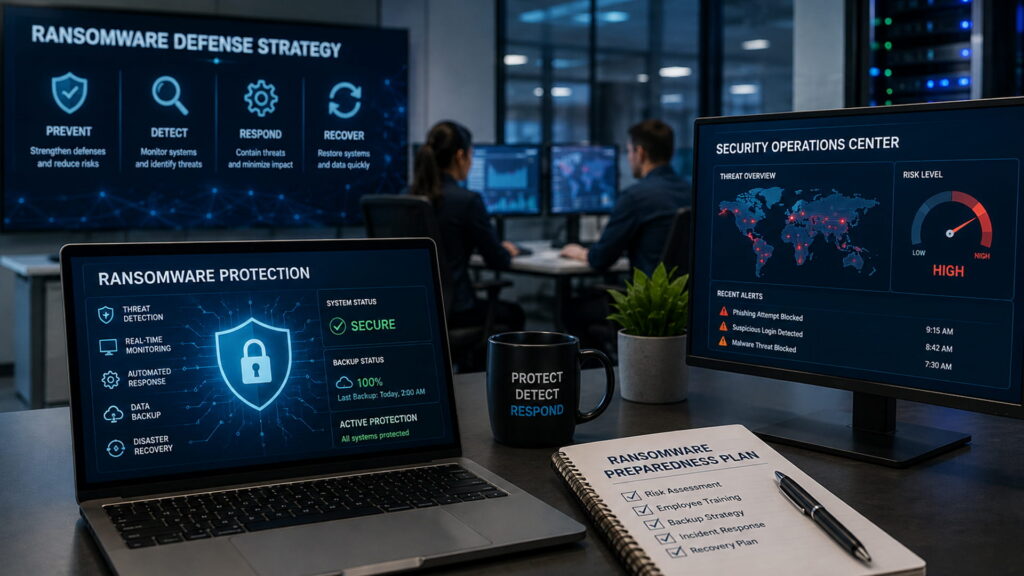
Ransomware has become one of the most damaging cybersecurity threats facing businesses today. A single successful attack can lock critical files, interrupt operations, expose sensitive data, and create significant financial losses.
Many organizations assume ransomware only affects large enterprises. However, small and medium-sized businesses are increasingly targeted because attackers often identify them as easier targets with fewer security resources.
In 2026, businesses need more than basic antivirus protection. Modern ransomware defense requires continuous monitoring, strong security controls, employee awareness, and reliable recovery planning.
Managed IT providers help businesses reduce ransomware risks by taking a proactive approach to cybersecurity. Through advanced security tools, ongoing monitoring, and strategic protection plans, MSPs help organizations prevent attacks and recover faster when incidents occur.
Quick Answer: How Do Managed IT Providers Protect Against Ransomware?
- MSPs protect businesses from ransomware through proactive monitoring, security tools, and prevention strategies.
- Managed IT providers implement backups and disaster recovery plans to restore operations quickly.
- Security monitoring helps identify suspicious activity before ransomware spreads.
- MSPs improve employee cybersecurity awareness to reduce phishing-related attacks.
- Regular updates, vulnerability management, and access controls strengthen overall protection.
What Is Ransomware?
Ransomware is a type of malware that prevents businesses from accessing their systems or data until attackers receive payment.
A ransomware attack typically follows this process:
- An attacker gains access to business systems.
- Malware spreads across devices and networks.
- Files are encrypted or stolen.
- Attackers demand payment for restoration.
Modern ransomware attacks have become more advanced. Attackers may not only encrypt files but also steal sensitive information and threaten to publish it publicly.
The impact can include:
- Business downtime
- Lost revenue
- Data exposure
- Customer trust issues
- Recovery expenses
A strong cybersecurity strategy focuses on preventing ransomware before it disrupts business operations.
Why Ransomware Protection Matters in 2026
Ransomware Attacks Are Becoming More Sophisticated
Cybercriminals continue improving their methods.
Modern attackers use:
- Automated attack tools
- Stolen credentials
- Social engineering
- AI-generated phishing campaigns
- Advanced malware techniques
Businesses need stronger protection than traditional security solutions can provide.
Small Businesses Are Increasingly Targeted
Many small businesses have valuable data but limited cybersecurity resources.
Attackers often target organizations with:
- Weak passwords
- Poor backup practices
- Outdated software
- Limited monitoring
Managed IT providers help small businesses access enterprise-level cybersecurity protection.
Downtime Creates Major Business Impact
A ransomware attack can stop important operations.
Businesses may lose access to:
- Customer information
- Financial systems
- Internal documents
- Business applications
- Communication platforms
The longer systems remain unavailable, the greater the financial impact.
Compliance Requirements Are Increasing
Many industries must protect sensitive information.
A ransomware incident can create:
- Regulatory problems
- Legal concerns
- Contract issues
- Customer notification requirements
Common Ways Ransomware Enters Business Systems
Phishing Emails
Phishing remains one of the most common ransomware delivery methods.
Employees may accidentally:
- Open malicious attachments
- Click infected links
- Enter credentials into fake websites
Stolen Passwords
Attackers often use compromised credentials to access business systems.
Weak password practices increase risk.
Unpatched Software
Outdated software may contain security vulnerabilities attackers can exploit.
Remote Access Weaknesses
Poorly secured remote access tools can provide entry points for attackers.
Malicious Downloads
Employees may unknowingly install infected software or files.
How Managed IT Providers Protect Businesses From Ransomware
1. Continuous Security Monitoring
MSPs monitor business systems continuously to detect unusual activity.
Monitoring can identify:
- Suspicious login attempts
- Malware behavior
- Unauthorized access
- Network anomalies
Early detection allows faster response before ransomware spreads.
2. Endpoint Protection
Every connected device represents a potential security risk.
Managed IT providers deploy endpoint security solutions to protect:
- Computers
- Laptops
- Servers
- Mobile devices
Endpoint protection helps detect and block malicious activity.
3. Multi-Factor Authentication
Passwords alone are not enough.
MSPs implement multi-factor authentication (MFA) to add additional identity verification.
MFA protects accounts even when passwords are compromised.
Businesses should enable MFA for:
- Email systems
- Cloud applications
- Administrative accounts
4. Regular Security Updates
Cybercriminals often exploit outdated systems.
MSPs manage:
- Software updates
- Security patches
- System maintenance
Keeping systems updated reduces vulnerabilities.
5. Email Security Protection
Because phishing is a major ransomware entry point, email security is essential.
MSPs help businesses implement:
- Spam filtering
- Phishing detection
- Email authentication
- Threat analysis
6. Employee Cybersecurity Training
Employees play a major role in ransomware prevention.
MSPs help businesses train employees on:
- Recognizing phishing emails
- Safe browsing practices
- Password security
- Reporting suspicious activity
7. Backup and Disaster Recovery
Backups are one of the most important ransomware defenses.
A reliable backup strategy allows businesses to restore systems without paying attackers.
Effective backup solutions include:
- Automated backups
- Secure storage
- Backup testing
- Recovery planning
8. Vulnerability Assessments
MSPs regularly evaluate systems to identify weaknesses.
Assessments help find:
- Security gaps
- Outdated software
- Weak configurations
- Access issues
Proactive MSP Security vs Reactive Ransomware Response
Reactive Approach
A reactive approach waits until an attack occurs.
The process usually involves:
- Discovering the attack
- Attempting recovery
- Repairing damaged systems
Problems include:
- Longer downtime
- Higher costs
- Data loss risks
Proactive Approach
A proactive MSP strategy focuses on prevention.
It includes:
- Continuous monitoring
- Security improvements
- Employee training
- Backup testing
- Risk management
Prevention reduces the likelihood and impact of ransomware incidents.
MSP Ransomware Protection Framework
Step 1: Security Assessment
The MSP reviews:
- Existing security controls
- Network environment
- User access
- Backup systems
Step 2: Risk Identification
Potential ransomware risks are identified.
Examples:
- Weak passwords
- Missing updates
- Poor backup strategies
- Vulnerable devices
Step 3: Security Implementation
The MSP deploys protection measures.
These may include:
- Endpoint security
- MFA
- Email protection
- Backup solutions
Step 4: Continuous Monitoring
Systems are monitored for suspicious behavior.
Step 5: Continuous Improvement and Compliance
Security strategies are updated as threats evolve.
Industry Examples: Ransomware Protection Needs
Healthcare
Healthcare organizations store sensitive patient information and require strong security controls.
MSPs help protect medical systems and maintain compliance.
Finance
Financial companies are attractive targets because they manage valuable financial information.
Legal
Law firms need protection for confidential client documents.
Retail
Retail businesses must secure payment systems and customer data.
SaaS Companies
Software companies need to protect applications and customer information.
Manufacturing
Manufacturers must protect operational systems that support production.
The Cost of Ignoring Ransomware Protection
A ransomware attack can create costs far beyond the ransom demand.
Businesses may experience:
- Lost revenue
- Employee downtime
- Recovery expenses
- Data restoration costs
- Customer loss
- Reputation damage
Investing in ransomware prevention is often significantly less expensive than recovering from an attack.
Frequently Asked Questions
No cybersecurity solution can guarantee complete prevention, but MSPs significantly reduce ransomware risk through layered security strategies.
MSPs use monitoring tools, endpoint protection, and security alerts to identify suspicious behavior.
Backups are essential, but businesses also need prevention, monitoring, and security controls.
Small businesses may have valuable data but fewer security resources, making them attractive targets.
Costs depend on business size, security requirements, and services needed.
Yes. Employee awareness reduces phishing and social engineering risks.
Conclusion: Build Strong Ransomware Protection Before an Attack Happens
Ransomware can create serious operational and financial damage for businesses of all sizes.
In 2026, organizations need proactive cybersecurity strategies that focus on prevention, detection, and recovery.
Managed IT providers help businesses strengthen ransomware defenses through monitoring, security solutions, employee training, and reliable backup systems.
By partnering with an experienced MSP, businesses can reduce cybersecurity risks, protect valuable data, and maintain business continuity.
Request a cybersecurity assessment today to identify vulnerabilities and improve your ransomware protection strategy.