
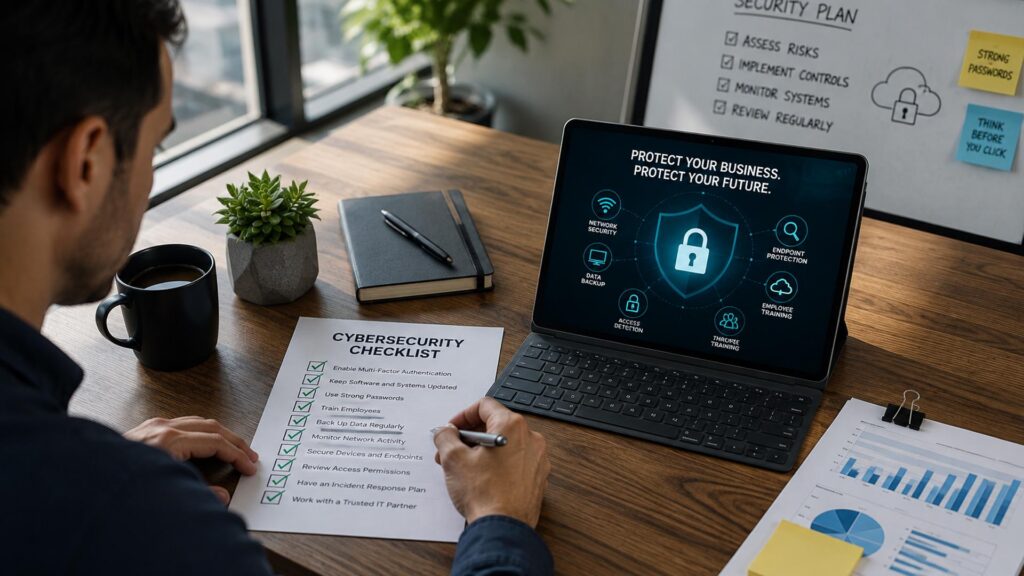
Cybersecurity is no longer only an IT concern. For small businesses, protecting digital systems, customer information, and business operations has become a critical priority.
Many small businesses assume cybercriminals only target large organizations. However, attackers increasingly focus on smaller companies because they often have limited security resources and weaker defenses.
A single cybersecurity incident can lead to financial losses, operational downtime, compliance issues, and reputation damage.
In 2026, businesses must take a proactive approach to cybersecurity. Strong protection requires more than antivirus software. Companies need layered security strategies, employee awareness, regular monitoring, and reliable recovery plans.
This cybersecurity checklist helps small businesses identify important security areas and strengthen their overall protection.
Quick Answer: Cybersecurity Checklist for Small Businesses
- Protect all devices with updated security software and endpoint protection.
- Enable multi-factor authentication across business accounts.
- Train employees to recognize phishing and cybersecurity threats.
- Maintain secure backups and test disaster recovery plans.
- Monitor systems continuously for suspicious activity and vulnerabilities.
- Work with cybersecurity professionals to improve protection and reduce risks.
What Is Cybersecurity for Small Businesses?
Cybersecurity refers to the practices, technologies, and processes used to protect business systems, networks, applications, and data from cyber threats.
For small businesses, cybersecurity means preventing unauthorized access, protecting sensitive information, and ensuring operations can continue safely.
A complete cybersecurity strategy includes:
- Network security
- Data protection
- Identity management
- Employee training
- Threat monitoring
- Backup and recovery
- Security policies
Cybersecurity is not a single tool or software solution. It is a combination of technology, processes, and employee awareness.
Many businesses use managed cybersecurity services to strengthen protection and gain access to security expertise without hiring a dedicated internal security team.
Why Cybersecurity Matters for Small Businesses in 2026
The cybersecurity landscape continues to evolve rapidly.
Businesses face increasing risks from advanced attacks, remote work environments, cloud platforms, and connected technologies.
Small Businesses Are Major Targets
Cybercriminals often target small businesses because they may have:
- Limited security budgets
- Outdated systems
- Weak passwords
- Lack of employee training
Attackers know that smaller organizations can still provide valuable access to:
- Customer data
- Financial information
- Business accounts
- Vendor networks
Ransomware Threats Continue Growing
Ransomware remains one of the biggest cybersecurity risks.
A ransomware attack can:
- Lock important files
- Stop business operations
- Demand payment
- Cause permanent data loss
Strong cybersecurity practices help reduce the likelihood and impact of ransomware incidents.
Cloud Security Has Become Essential
Businesses increasingly rely on cloud platforms for:
- File storage
- Collaboration
- Business applications
Cloud systems require proper security controls, access management, and monitoring.
Compliance Expectations Are Increasing
Many industries require businesses to protect sensitive information.
Cybersecurity helps organizations meet expectations related to:
- Data protection
- Customer privacy
- Industry regulations
- Business partnerships
Small Business Cybersecurity Checklist for 2026
1. Enable Multi-Factor Authentication
Passwords alone are no longer enough.
Multi-factor authentication (MFA) adds an additional layer of security by requiring users to verify their identity through another method.
Examples include:
- Authentication apps
- Security keys
- Verification codes
MFA helps protect accounts even if passwords are stolen.
Businesses should enable MFA for:
- Email accounts
- Cloud applications
- Financial systems
- Administrative accounts
2. Train Employees on Cybersecurity Awareness
Employees are one of the most important parts of cybersecurity.
Many cyberattacks begin with human mistakes, such as clicking malicious links or sharing login information.
Regular cybersecurity training should cover:
- Phishing awareness
- Password security
- Safe browsing habits
- Suspicious email identification
- Social engineering attacks
A well-trained team can prevent many security incidents.
3. Keep Software and Systems Updated
Outdated software creates security vulnerabilities.
Businesses should regularly update:
- Operating systems
- Applications
- Security tools
- Network equipment
Security patches often fix vulnerabilities attackers may exploit.
4. Use Strong Password Policies
Weak passwords remain a common security problem.
Businesses should require:
- Strong passwords
- Unique passwords for accounts
- Password managers
- Regular security reviews
Employees should avoid using the same password across multiple platforms.
5. Protect Business Email
Email remains one of the most common attack methods.
Businesses should implement:
- Email filtering
- Spam protection
- Phishing detection
- Security awareness training
Business email compromise attacks can lead to financial losses and data exposure.
6. Secure Endpoints and Devices
Every laptop, desktop, and mobile device connected to business systems creates a potential security risk.
Endpoint protection helps monitor and secure devices.
Businesses should use:
- Antivirus protection
- Endpoint detection tools
- Device encryption
- Remote management
7. Maintain Reliable Backups
Backups are essential for business continuity.
A strong backup strategy should include:
- Automated backups
- Secure storage
- Regular testing
- Recovery planning
Backups help businesses recover after:
- Ransomware attacks
- Hardware failures
- Accidental deletion
- System failures
8. Monitor Network Activity
Continuous monitoring helps identify suspicious behavior.
Businesses should monitor:
- Login activity
- Network traffic
- Security alerts
- Device behavior
Early detection allows faster response.
9. Create a Cybersecurity Policy
A cybersecurity policy provides clear guidelines for employees.
Policies should address:
- Password usage
- Device security
- Remote access
- Data handling
- Incident response
Clear policies reduce confusion and improve security awareness.
10. Develop an Incident Response Plan
No security strategy is complete without preparation.
An incident response plan should define:
- Who responds to attacks
- How systems are isolated
- How recovery happens
- How customers are informed
Preparation helps reduce damage during a cyber incident.
Common Cybersecurity Mistakes Small Businesses Make
Using Weak Passwords
Simple passwords increase the risk of unauthorized access.
Ignoring Software Updates
Unpatched systems create opportunities for attackers.
Lack of Employee Training
Employees may unknowingly expose the business to threats.
No Tested Backup Plan
Backups that are not tested may fail during recovery.
Assuming Small Businesses Are Safe
Cybercriminals target organizations of all sizes.
How Managed IT Providers Improve Cybersecurity
Managed service providers help small businesses build stronger security defenses.
An MSP cybersecurity strategy may include:
Security Assessment
The provider evaluates existing systems and identifies weaknesses.
Threat Monitoring
Security tools continuously monitor activity for suspicious behavior.
Security Implementation
MSPs deploy:
- Endpoint protection
- Email security
- Firewalls
- Access controls
Ongoing Management
Cybersecurity requires continuous improvement.
MSPs regularly review:
- Security alerts
- System updates
- Vulnerabilities
- Compliance requirements
Step-by-Step Framework: Building a Small Business Cybersecurity Strategy
Step 1: Assessment
Review current security practices.
Evaluate:
- Devices
- Applications
- Access controls
- Existing security tools
Step 2: Risk Identification
Identify cybersecurity weaknesses.
Common risks include:
- Weak passwords
- Outdated software
- Missing backups
- Poor employee awareness
Step 3: Implementation
Deploy security improvements.
Examples:
- MFA
- Endpoint protection
- Backup solutions
- Email security
Step 4: Monitoring
Continuously monitor systems for threats.
Step 5: Continuous Improvement and Compliance
Regularly update security practices based on new threats and business requirements.
Cybersecurity Use Cases Across Industries
Healthcare
Healthcare organizations must protect sensitive patient information and maintain secure systems.
Finance
Financial businesses require strong controls to protect customer data and transactions.
Legal
Law firms need cybersecurity solutions to protect confidential client documents.
Retail
Retail businesses must secure payment systems and customer information.
SaaS Companies
Software companies need strong security to protect platforms and customer data.
Manufacturing
Manufacturers must protect operational technology and connected systems.
Cost of Ignoring Cybersecurity
Cybersecurity failures can create significant financial impact.
Costs may include:
- Data recovery expenses
- Lost revenue
- Business downtime
- Regulatory penalties
- Customer loss
- Reputation damage
Investing in cybersecurity is often less expensive than recovering from an attack.
Frequently Asked Questions
Small businesses should use MFA, employee training, backups, endpoint protection, software updates, and continuous monitoring.
Small businesses are common targets for cybercriminals and need protection against data breaches, ransomware, and financial fraud.
Major threats include ransomware, phishing, credential theft, malware, and business email compromise.
Yes. MSPs provide cybersecurity monitoring, security tools, assessments, and ongoing protection.
Costs vary based on business size, security requirements, and services needed.
No. Modern cybersecurity requires multiple layers of protection, including monitoring, access controls, backups, and employee training.
Conclusion: Protect Your Business With a Strong Cybersecurity Strategy
Cybersecurity is now a business priority, not just an IT responsibility.
Small businesses face increasing threats in 2026, and protecting systems requires a proactive approach.
By following a strong cybersecurity checklist, businesses can reduce risks, protect valuable information, and maintain customer trust.
Partnering with a managed IT provider gives businesses access to cybersecurity expertise, advanced tools, and ongoing protection.
Request a cybersecurity assessment today to identify vulnerabilities and build a stronger security strategy for your business.